The Voice of Job Seekers

Mark Anthony Dyson ★ Career Writer ★ Speaker ★ Thinker ★ Award-winning Blog & Podcast! ★ "The Job Scam Report" on Substack! ★ I hack and reimagine the modern job search!

  • TVOJS Podcast
    • Guest Posts Topics or Podcast Guests
  • ABOUT ME
  • Press page for Mark
  • Hire Mark to Speak
  • Hire Me for Content Writing
  • Guides & Resources 2023
  • Press Bylines
  • PRESS MENTIONS
  • Articles
  • Guides & Resources

by Mark Anthony Dyson

6 Bold Job Search Strategies That Will Challenge Your Thinking

6 Bold Job Search Strategies That Will Challenge Your Thinking

6 Bold Job Search Strategies That Will Challenge Your Thinking by Mark Anthony Dyson

If you’re tired of applying to job boards, and no one of hiring significance is paying you any mind, keep reading. You’ve heard it’s not a numbers game where the more you apply, the increase your hiring chances. In 1990, this was a helpful strategy, but in 2015, more was needed. Your friends say it works, but it’s been five years since they’ve looked.

I warn you, career practitioners will roll their eyes when they read this article.

How many times have you tweaked your resume to no avail?

I understand lousy job search advice is everywhere, but so is excellent and meaningful information is still at your fingertips. In 2015, on an episode of “The Voice of Job Seekers,” Jim Stroud offered some of his strategies own he wrote for his book, “The Number One Job Hunting Book in the World!” 

I think they are still daring to suggest to job seekers in 2023. But, since YouTube and podcasts are real media channels for any potential user to grow an audience, monetize it, and influence many, why not suggest it? Regardless of how few succeed, it’s as viable. 

If you listen to much of what we discussed, you should concentrate on being more visible than forcing your way to be seen. No one will remember you if you look like the rest of the ducks. During your job hunt, be the lead duck or the different one. Just don’t be the lame duck or the same duck. Do you dig?

1. Add value to relationships without asking for reciprocation (at least for some time)

Why not be helpful during your job hunt? Although we are not talking about taking out someone’s garbage or washing some stranger’s car, we are talking about being a resource or helping make life easier for someone. If someone offers immediately to reciprocate, then ask without inundating them (wash my hands, feet, clothes, and car, please will get you to block, if you know what I mean). Online, it’s done in many ways, but to name a few:

  • Articles, links, or quick tips to a free or low-cost resource
  • A “how-to” phone call teaching someone how to do something
  • An encouraging tweet, note, or phone call for no reason
  • Providing the help they need to improve a website, comment or share their resource
  • Provide a contact for someone else to get a job

2. Get on someone’s podcast, video show, or guest post on a popular blog

Stroud suggests you go to iTunes, look for your industry’s subject in podcast form, and pitch to get on a show so you “…can position yourself as an expert.” Or go to YouTube, explore the video shows in your niche, and pitch an interview idea to help you appear as the “go-to person.”

3. Go to your community radio station and do a weekly show

Go to your local community or college radio station to pitch a show interviewing local experts, or be the expert yourself. You can do the same with a podcast (local or national experts will get you international listens if it doesn’t scare you). As you talk with experts, you will be seen as an expert. Some won’t let you use it to promote your small business, but others will allow almost any content. Of course, you want something to boost your expertise and experience.

4. Target large companies so other large companies can hire you

Stroud also shared with us, “… by focusing on top companies or startups winning awards or growing in popularity, you become attractive to their competitors. Under working at Verizon, you automatically look attractive to AT&T and Sprint.” Again, the theme is to gain visibility and not gain attempts. It will figure into your career trajectory for years to come. This job hunt can’t be a temporary solution, even if the job is a short-term contract.

 5. Volunteer

By now, you can find countless stories of careers by people who started as a volunteer. I wrote about it a couple of years ago, reasoning how there is no reason not to volunteer. You don’t have to volunteer even full-time to create a valuable experience. Don’t wait for your options to run thin to volunteer. Here’s a more recent and robust article to read. 

6. Go Mobile, Young Man/Woman

I dare you to write an article on your LinkedIn platform and provide a reading of the paper too. You can use SoundCloud to embed on LinkedIn (it’s the only audio service LinkedIn allows the player for people to listen right there). You can also do it via YouTube (for the bold, as YouTube is the only video player anyone can embed). This way, those who frequently use the LinkedIn app will access your article through a mobile device, particularly when they don’t feel like reading. When you publish it, curious people click play and keep moving. 

Pick one of these strategies today and focus on a career with a longer-term return. Notice some of the strategies require forms of selflessness. It has a great return, but it does require a little faith. By no means are these suggestions for only desperate job seekers. These are creative suggestions for the dog days of your job hunt and those wanting to level up their branding efforts. If you want to be seen differently than the other 100 applicants for positions you apply for, be different and try alternative methods.

How many times are you going to tweak your resume?

This article first appeared on LinkedIn. I sprinkled an extra point. Let me know your thoughts.

Filed Under: Job Search Tagged With: Job Hunt

by Mark Anthony Dyson

How To Show Your Brand is More Than Your Title

How To Show Your Brand is More Than Your Title

I want to share my annual thoughts on job search trends that are slightly different this year. Instead of one list where I share a list, I want to dive deeper into each one I share and then write a round-up linking to each article.

Let’s start by stating the obvious. You’ve heard me say that job search is a lifestyle. You’re going to need to market the brand you have. It’s more than titles, acronyms, and letters behind your name unless it’s an M.D., JD., and others. Even MBA letters behind a name have lost their essence.  It won’t evolve into anything significant until it’s visible with applied knowledge.

If you differentiate yourself from your peers and competitors, you’ll lump yourself in. It would help if you wanted to stand out, but listening to many folks who are telling you a brand is something you create. If you’re making a persona instead of exploiting the one that markets yourself, you’re doing it wrong.

Yep. I used “markets.” Get used to it as of right now. We’re all trying to get some visibility. It’s not magic. It’s intention.

Let’s talk about the title with the letters behind it. Many experts will say on LinkedIn it doesn’t matter.  Titles are marketing if they’re useful and universally known. Labels are marketing if you do something only 50 people in the world do. Titles are helpful when you are professionally involved in an industry where you’re paid to have those skills, and everyone knows what it is. OK, so maybe I’m wrong about this. It may get you some helpful LinkedIn SEO.

But it’s not your brand.

I’ll argue if you can’t capture your brand in the fewest words possible, you’re thwarting your marketing efforts. It works well spent if you want your brand and work to be its referral engine. People need to scan and click. Take their thinking from them, and infuse it wherever possible, with as fewest words as possible.

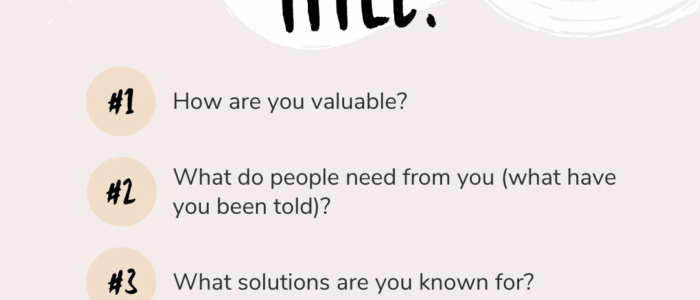
We’re remote, and we’re online. Present yourself as a gold mine, not a land mine:

  1. How are you valuable?
  2. What do people need from you (what have you been told)?
  3. What solutions are you known for?

You have to explain a title; if you have three inexplicable titles, people may not ask anything of you.

My wife and I contracted our electrical work to George for many years. George has been our go-to guy for whatever electrical job we needed for our two-flat. We thought that’s all he did, and in fact, we also enjoyed his company. We know that he also owned several pieces of property.

We didn’t know he retired from the government after 32 years of finding hidden money as a tax accountant. We didn’t realize this until this year about George.

If we’d known, it wouldn’t change our relationship with him. But he only wanted us to understand what is relevant to us. George solved one problem for us. He has received many referrals from us just for the work he’s done for us. George created the demand for his work only as an electrician for us.

Be like George.

Filed Under: Personal Branding Tagged With: branding, Personal brand, Personal branding

by Mark Anthony Dyson

How to Request a Demotion In The Nicest Way Possible

How to Request a Demotion In The Nicest Way Possible by Mark Anthony Dyson

Some professionals will see a demotion of quitting or feel unprovoked shame if they ask for a demotion. If you are a highly self-aware professional, you already know a demotion is a leverage for your next career move. For everyone else, a downgrade in responsibility is perceived as unimaginable. Demotions can be a strategy to retool or refresh an otherwise stale career track. 

This is not a sexy topic because these days, the talk is more about negotiating or at least trying to get more money. The most successful negotiation I’ve seen or experienced is not getting more money but achieving a job satisfaction fit. From the beginning, my work life and career share a space of toggling peace and production for the job. More money is often, but not exclusive, to performance enhancement. It’s a climb uphill, associated with exhaustion and results, and many professionals live to gain career collateral.

On the way to success, many need relationships for introductions and strategy, but I submit the same is required for a more strategic demotion. Stress relief is enough to ask, but it can be the tool you won’t get with promotions: The space for retooling and re-energizing.

Lessons from fitness

As a former personal trainer, and even now, as someone who trains regularly, I see it every day at a gym. You injured yourself and can’t lift the heavier weight due to something wrong with the fundamental structure or heal the injury. Sometimes, the damage is bound to happen because of the improper technique using the exercise basics. 

The sexiest thing for men is to show they can squat or bench press a lot of weight. It’s always been that way. We pride ourselves on our physical strength (despite how unimpressed others are). When we can no longer squat or become injured during a squat or a bench press, we stop doing it forever. Only a few will work on doing exercises (while healing) to improve our form or technique. Sometimes, it means doing warm-up activities involving less weight and slowing our roll. 

Whether it’s a shoulder (bench press) or a quadricep (squat) injury, there are exercises to help facilitate better mobility and improve technique. These exercises often help alleviate the pain and discomfort injuries produce. Some men gut it out to reinjure it and never repair the damage. Some would never try those movements again for fear of pain or not wanting to do the rehab work. 

Demotions, in a positive way, are the rehab exercises, often meant to do something more meaningful and require a heavier lift. There’s nothing wrong with getting out of a stressful position due to stress. I’ve done it. To build a more substantial structure, tear down the older, weakened one and rebuilt one with a stronger foundation. 

There are reasons to fear demotions.

Demotions are perceived as weakness and often hurt us when the load is too much. Here are a few common reasons someone hesitates to request a demotion:

  • You feel you are letting the team down. While pushing through is easy, you have nothing to motivate you to keep going. 
  • Your original motivation is gone. You started vigorously for the cause but are burning out through letdowns and disappointments, whether through shortcomings or lack of support from the team or management. 
  • You see a better way to serve. I remember leaving work committees because it wasn’t doing my advancement. It indirectly caused me to rise as coworkers on the committees I worked on received promotions by upper management to leadership positions. When I switched responsibilities, I discovered a better way to serve, giving me more exposure. It wouldn’t have happened without saying “no” before my eventual promotion. 
  • The position is undervalued. While others don’t recognize your value, you see your access to tools, resources, and others is limited. Not only it’s not reflected in the pay, but also respect. Staying would be undignified, and your efforts go unnoticed. 
  • The fear of negatively impacting your relationships with your team. Many workers find a demotion scales their relationships in the way of being a resource for new and former teammates. I experienced resigning from a management position to a non-management place and being seen as valuable because I had a view of the bigger picture. Caveat: Sometimes, there are complications when seeking a non-management position after being a manager for several years. That can be navigated easier when you demonstrate how your experience is an asset to your new team.

Sometimes it may take several conversations to convey and structure a step-away plan, but it’s better on your terms. For this conversation, I offer suggestions on starting, but finishing is contingent on your thoughtfulness and research:

1) They don’t want to lead a team

A good example is when a manager with direct reports gets clear they no longer want the stress of leading a team but have other skills valuable to the department or company and can leverage a move in a way that serves themselves and others. They could still be a valuable resource because of their internal/external relationships with clients and other company areas.

How to start the ask: It helps to be specific and start with the positives of what they learned from the team and their boss but no longer finds meaning in work. They will be helpful as a resource and help make a smooth transition.

2) They may need career clarity

Skills have a shelf life, and they seek to add new skills to converge into a new area. Pulling back in responsibilities (and, at times, less pay) makes sense, knowing there is a bigger picture with more income to upgrade skills.

How to start the ask: While it may be a concern you might leave the company, they will benefit the most by being diplomatic. Having a plan where they can add value will temper questions about going. The “I can be much more of an asset while being accessible” approach works often. It may not keep a manager wondering, but they will appreciate you are interested in remaining a key contributor.

3) They are not on the same page as their boss/team/team leader

Savvy employees who don’t share the values of their leader still want to do meaningful work but feel they would be an asset in another role with a more progressive leader. It makes sense to step back to serve in another capacity where the skills and challenges are more meaningful.

How to start the ask: Sometimes, the manager will take this personally, and at times, it’s apparent two people see things differently. The emotion has to be taken out of the request to step down. Some managers will take it personally when someone wants to move to another position or make a voluntary demotion or lateral move. Position the spirit of the ask the move would be in the team’s best interest, “I see the team thriving without me” carries better.

4) Diminished zeal for the work

Interests change, and the employee has found a new purpose. This job no longer aligns with their unique goals. If they don’t want to leave the company and their performance is still on par, it would still help to be specific about how they envision the plus side of change.

How to start the ask: “I see another way to do this work, bringing us into new technology and saving money and time.”


Most professionals must reframe demotions to shift from what may lack in purpose could change to what they value. Jobs have a shelf life, but it’s different for each person. Assuming the original promotion was to a management position, there’s usually a shift in responsibilities during a management tenure. This may result in a lack of interest or burnout. There’s nothing wrong with crying “uncle” and moving on. It helps to be strategic, but it’s not always possible.

Filed Under: demotion Tagged With: demotions

  • « Previous Page
  • 1
  • …
  • 36
  • 37
  • 38
  • 39
  • 40
  • …
  • 265
  • Next Page »

Join the email list and get “12 Modern Job Search Strategies Beyond the Resume 2022”

Download free

The Fortune For Your Career Is In The Follow-up

Download free

I moderated a panel on Wealth Management for executives by Black Enterprise Magazine in October 2023 in Miami.

I was interviewed on Scripps News show, “The Why!” 4/13/2023

I talked with John Tarnoff and Kerry Hannon of “The Second Act” podcast about job searching after 50 in October 2022.

I was on “The Career Confidante” podcast to talk about “boomerang employees” and “job fishing” in June 2022.

Making Job Search a Lifestyle With “Dr. Dawn Graham on Careers,” SiriusXM Ch. 132, Wharton School of Business May 2021

In October 2025, I was interviewed by Nafo Savo, of Marketplace Tech, National Public Radio show

Beverly Jones, host of the NPR podcast “Jazzed About Work,” invited me back to talk job scams, job search trends, and AI tools in April 2024

WOUB Digital · Episode 183 : Job search expert Mark Dyson says beware of scams, know AI & keep learning

Copyright © 2026 · Generate Pro on Genesis Framework · WordPress · Log in